Thursday, June 25, 2009

Mobile payment systems in Malaysia : Its potential and consumers' adoption strategies

1 comments
Mobile payments is a collection of money from consumer via a mobile device such as their mobile phone, Smartphone, Personal Digital Assistant (PDA) or any other devices. With such application, it brings benefits to the world of e-commerce and it is relatively growing in Malaysia as well.

Some of examples of mobile payments available in Malaysia are mobileExec and Mobile Money. Both are using the concept of making payment transactions just through a mobile device to pay for goods and services anytime without having cash on hand, cheques or even physically present a store. This will be easier and more convenient for users as they go about anywhere to make purchasing.

Companies such as Maxis; HGL Capital Berhad; CELCOM are also coming up with this concept to cater for their customers convenience. Mobile payments services indeed have a great potential and advantage. Consumers are more comfortable with low-value transactions over such non-traditional means. Common applications will include payment for transportation, parking, restaurants, convenience stores, retail outlets, e-tickets to name a few – typically for low-value items. This helps especially when consumers are in need of cash but doesn’t have any in hand, therefore with mobile payments they do not need to even search for an ATM machine to withdraw the needed money for the payment.

The threat of online security

1 comments
It is important to be aware that there are certain types of online threats that will cause a whole lot of problems such as data loss and reprogramming the computer system. Therefore, online security has become an enormous concern when surfing the net. Nowadays, computer users are facing the threats of cyber crime, phishing, internet and network attacks such as computer viruses, worms and Trojan horses and back doors.

1) Viruses
Virus is a piece of software code that inserts itself into a host, including the operations systems. The virus is activated once its host program be executed and attempts to copy itself into more program. Viruses may simply infect and spread; others do substantial damage such as deleting files or corrupting the hard drive. For example, "I LOVE YOU" virus caused over $100 million in United States damages and over $1 billion in worldwide losses.


2) Worms
Worm is a self-replicating software program, consuming the resources of its host in order to maintain its capable of propagating a complete working version of itself onto another machine. It uses networks to spread itself or spread through instant messages; it does infect a computer or hand held device without human intervention. Macro virus or macro worm is executed when the application object that contains the macro is opened or a particular procedure is executed.

3)Trojan horses
A program that appears to have useful function but contains a hidden function which presents a security risk is known as Trojan horse. Trojan horse is unlike a worm, it requires user cooperation. Once on your machine, Trojans then function as independent programs that operate secretly. Commonly, Trojans steal passwords or perform "denial of service" attacks. Examples of Trojans include Backdoor and Nucker.

Sunday, June 21, 2009

Corporate blog- a new communication tool for the companies

1 comments
Blog became more and more popular recently. Corporate blog is one of the weblog that used publicly by an organization to publish about themselves, products and services. The important is the copyright is belonging to the organization.

Corporate blog consists of 2 main types which are internal and external blog.
1) Internal blog – Blog that can be viewed by the company’s employees by using the company’s Intranet. It is mostly used in the meetings or e-mail discussions from different geographical location. Thus, it is available for all the employees who do not have been invited or took part in those meetings or discussion to provide their expertise. Thus, it can build a strong relationship between the company and employees.


2) External blog – Blog that publicly available to announce the new products and services, notify the company policies, sharing views for certain issues. It is useful than the traditional press releases. All of the posts will reviewed and commented before post publicly. It is including the additional information which is unobtainable from a standard corporate website and thus increased the transparency and accessibility of the company image.


The corporate blog is useful because some of the reasons:

1) Update easily- Blogs will keep the content new and dynamic because it is easier to update whichever internally or externally.
2) Two-way communications channel – Blogs allow readers to post their comments or participate in the discussion. The company also need to provide additional message which different with those information that they get from the company website.
3) Time management – It will just take some time to update compare with pod casting. Hence, it is easier to manage and communicates the company news, culture, information with all the people around the world quickly and easily.

Although corporate blog is easier to create, but there is still some mistake which is done by some of the company.

1) No specific goal – Easy to set up result in the various types of new blogs. Thus, it is difficult for the company to be special and caught the readers’ attention.
2) Not keeping maintains – Treated as an experiment.
3) Not sourcing content – Hard pressed to write a good content if does not make editorially.

The examples of corporate blogs:
Johnson & Johnson: JNJ BTW
Yahoo!'s Yodel Anecdotal
Network Solutions, Solutions Are Power
Coca-Cola Conversations
SUPERSEED (charity blog, Asia)
eBay Ink


We are here sharing the video relates to usefulness of corporate blog

http://vizedu.com/2009/03/corporate-blogs-challenges-and-success-factors/

Electronic currency

1 comments

Electronic currency is refers to exchanging or trading the money electronically. A person is able to make payment for the goods or services through the internet. E-currency just like real cash and it is reusable. It has been widely in use in the countries like Singapore and Hong Kong. For instance, direct deposit and Electronic Funds Transfer (EFT) is the main types of the e-currency.

Why electronic currency is created?

As there is the increasing of the criminal case, it creates a lot of troublesome issue if carried a lot of paper money in hand. In order to protect for the users, credit cards, debit cards, online banking, exchanging of electronic currency ahs been created. It has lessened the usage of the paper money and convenient to the users.

There are some advantages of the electronic currency.

1) E-currency provides the confidentiality and privacy for the users. When users sent an e-currency amount to the businesses, it does not contain any private information to the businesses. It is totally different with the credit card system.

2) Security of E-currency is strengthened by using the encryption which is known as RSA cryptography. It requires the authorities to use a trustworthy system and eliminate the risk of breaking the code of a digital signature.

3) As the users are able to transfer the e-currency through the internet, it saves time for the users without going out to the bank to make transaction.

However, there are still some drawbacks of the electronic currency.

1) The major problem may occur is fraud. If users accidentally misplace their private key, the perpetrator may use this opportunity to withdraw their money.

2) Peer-to-peer double spending of digital coins. Let say the users choose not to involve bank as an intermediary. If the digital coins are sent to the wrong places, they have to bear their losses.

Electronic currency has brought a lot of benefit for the users. Nevertheless, there is still need more improvement in the research and development to reduce the risk of disadvantages faced by the users especially fraud.

Ebay is one of the example that are using e-currency.

Friday, June 19, 2009

Another example of e-commerce success and its causes

2 comments
Dell.com is an extremely successful e-commerce business. By using online system, we can purchase Dell product at home and get it in timely. It is a popular product among computer technology consumer.

There some keys of successful in Dell e-commerce:
1) Customers and suppliers
Dell perceived that both customers and suppliers must be treated as collaborators and co-workers. They have approached their customers in the best products and provide effective services. For instance, Dell can meet customer’s needs quickly by delivering the products in the right time. Instead, they tend to build a good relationship with their suppliers and customers and bring up open communications with each other.

2)
JIT system
Dell known as a leader in supply chain management a
nd just-in-time manufacturing. By using just-in-time system, dell successes to increase their revenue by eliminate inventory cost and storage cost. The key to accomplish this strategy is keeps the same suppliers and increase supplier to manage inventory for Dell.

3) Team member
Dell believes that their team will continue to develop, retain, and grow in e-commerce. Dell holds a Platinum council
s twice a year in each region of the world. This meeting consists of around 100 members of company’s senior management and customers to share their concerns and discuss the technology changes. Their main purpose is to know the needs of the customer and fulfill their needs.

4) Tools
Dell is using personalization and customization tools. Dell create a special Premier Page to its own main corporate customer. Premier Page involves all products that covered purchasing contracts and special pricing under the contract with that firm. This can guarantee customer will get a fair price for each purchase.

Thursday, June 18, 2009

Do you actually kno what is mean by phishing???

3 comments
I believe that almost everyone has been received scam email before. Those email look like sent by a famous or trustworthy website that ask for your personal information. It is actually known as phishing email.
The perpetrators will usually send phishing email by several ways.

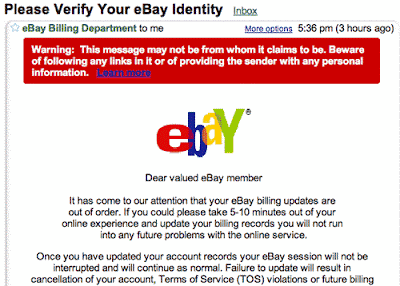
1) Phishing emails may ask to “verify the account”
For example, phishing email may act like Yahoo that asks to update credit card information.

Or ask to verify eBay identity:


2) Be aware the phrase of “Dear valued customer” or “First generic bank user”.
Most probably phishing email do not contain customer’s name.


http://www.phishtank.com/what_is_phishing.php

3) If phishing email contains customer’s name, remember check the anonymous link before click on it. Sometimes, the link that senses of urgency may usually mask. It usually the full name of the company but does not bring to that address.


http://www.microsoft.com/athome/security/email/phishing.mspx?ifs=0

Another example of phishing mail through the msn. However, they will require login first before go into that website. this is the way that the perpetrators steal users private information.


In order to prevent from becoming the next victim, there are some ways that helps to prevent from phishing.
1) Do not reply the email that asking the personal information.
It is because most of the businesses will not ask the personal information through email. If believe that the email is legitimate, do not hesitate to call the number to check for details.

2) If there are any suspicious activity, review the banking and credit card statement monthly or call to the banks to ask for details.

3) Microsoft have come out with a phishing filter block which available in Internet Explorer 7. When detecting an unknown website, it will display a red warning page that blocks phishing email.

For our own safety, we must remember not to click the link inside the email. If you feel suspicious, types the correct URL by hand and login to your own account. Besides, I think that we should usually change our password to avoid the scammers. Otherwise will be get fooled by the perpetrators unfortunately.

For those related video can refer to http://www.youtube.com/watch?v=sqRZGhiHGxg

Boo.com failure and its causes

2 comments

As we have seen the factors that help in the success of Amazon.com in the previous post, there are however a large number of e-commerce companies that are not able to maintain their profit through e-commerce. Some well-known business-to-consumers (B2C) failures include eToys, Xpeditor, Chemdex.com and Webvan.com.

One of it includes Boo.com. It beset with problems and mismanagement from the beginning. The site relied heavily on JavaScript and Flash technology. The dial-up Internet usage was a norm and it has a very small bandwidth. Hence, it time consuming. The complicated design required to be displayed in a fixed size windows limits the space available to display product information to customer. Customers find it as an ineffective way to search for wanted information.

Boo.com’s founders spent £125 million in just six months, to market itself as a global company but then had to deal with different languages, pricing and tax structures in countries it served. Their sales wasn’t up to their expectation, especially when there were a high numbers of returned products by their customers (the company mysteriously decided to pay postage on returns).
 

E- Evolution Copyright 2008 Shoppaholic Designed by Ipiet Templates Image by Tadpole's Notez